First International Hire OS
You found the right developer abroad.
Contractor, employee, or EOR?
Mexico, India, the Philippines — anywhere.
The provider-neutral operating file for a small software or agency team hiring its first person abroad in the next 90 days: decide the path, cost it honestly, prepare for counsel, and hand off a 30-day plan.
Planning data from official government sources for the 12 countries where small teams hire most, plus Brazil, Ireland, Poland, Portugal, and South Africa, with any gaps marked. A step-by-step method for anywhere else.
Listen: the 5-minute explainer
Contractor vs. employee vs. EOR, in plain English5:16AI-voiced
Or start with the free true-cost calculator or the misclassification risk checker. No email required to try them.
- Free 10-point checklist
- Sources dated Nov 15, 2026
- Provider-neutral
Actual kit pages, rendered from the kit files.
- Sources
- Cited and dated — last checked Nov 15, 2026
- Formats
- PDF guides + fill-in worksheets and templates
- Country scope
- Kit: 13 countries; free calculator adds Ireland, Poland, Portugal, South Africa
- Last updated
- Nov 15, 2026
- Inventory
- Up to 12 items — listed in full below
Free · two one-page PDFs
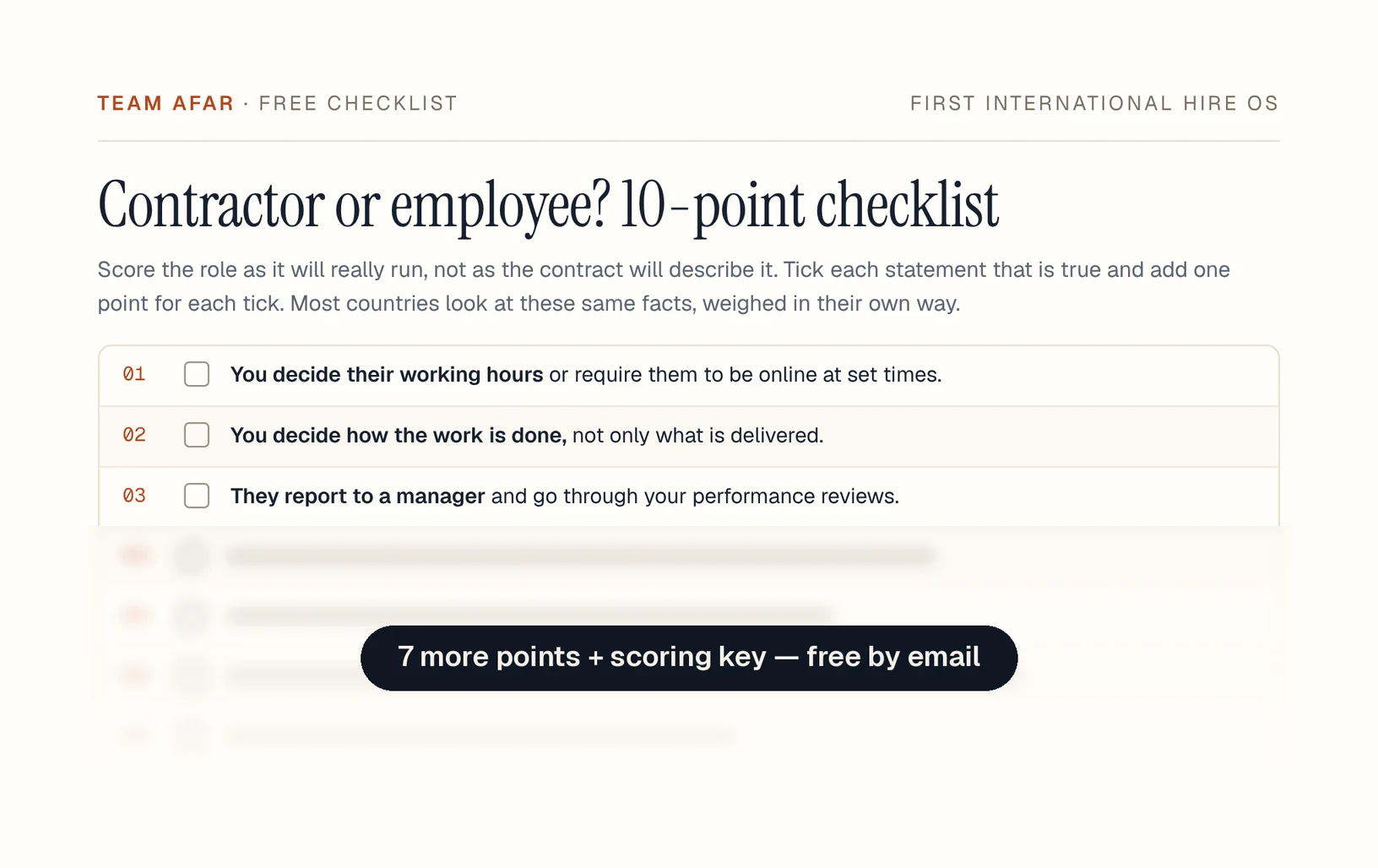
Contractor or employee? Score the role in 10 points.
Ten facts most countries look at, a score that tells you when to call counsel, and the four-question decision tree that opens the kit. Use them before you tell the candidate how they’ll be paid.
You can also score the role in the free risk checker or estimate cost in the true-cost calculator, with official sources on every country page. No email required to try them.
Look inside
See the actual files before you pay.
Real pages from the kit, not mockups. Click any page to zoom in, or read three full excerpts — no email needed.
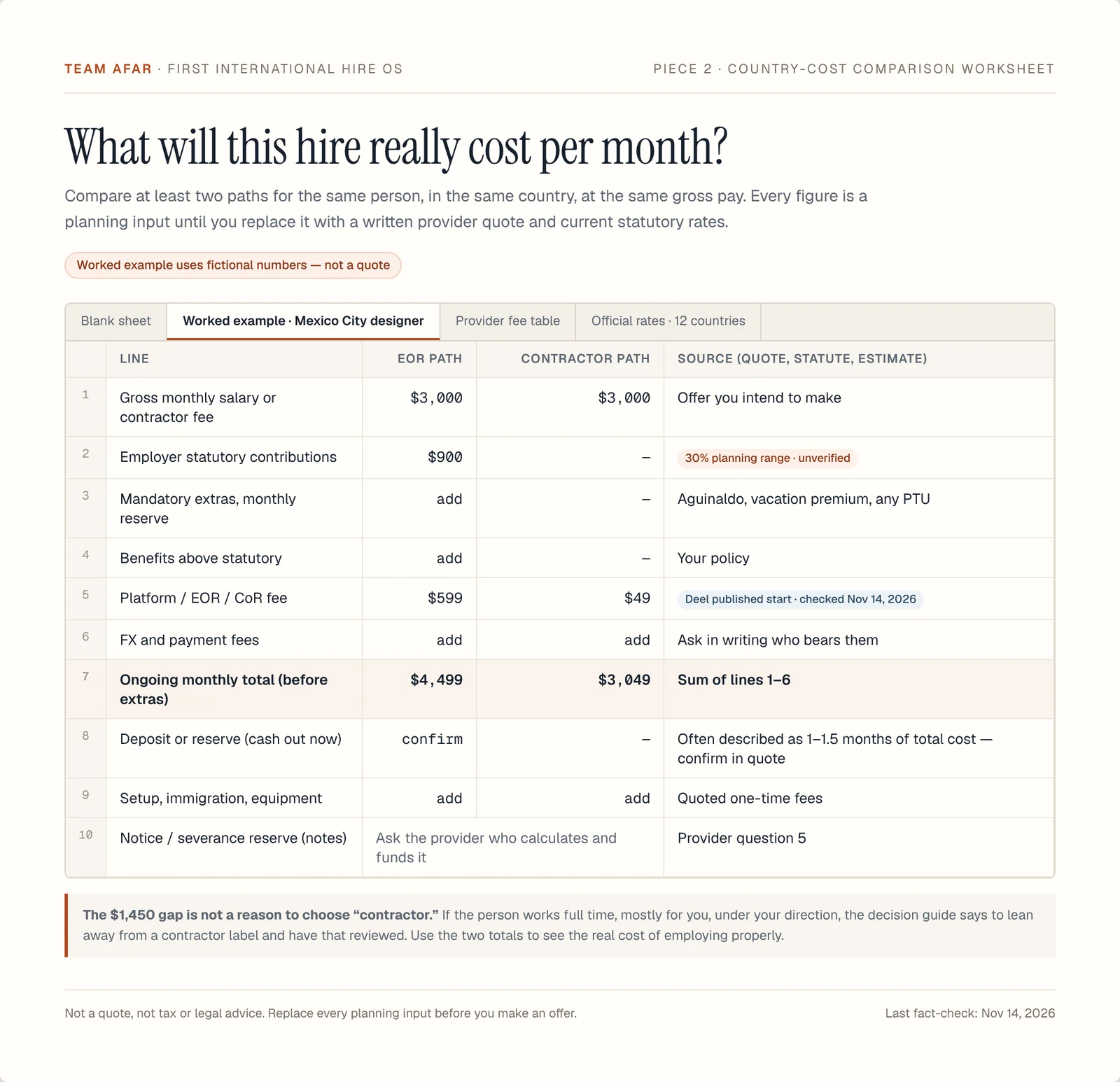
Country-cost comparison worksheet
EOR vs contractor, line by line, with a source column. The worked example is fictional and labelled that way; the platform fees are Deel’s published starting prices.
Cost calculator (.xlsx) — 14 sourced country presets
The Calculator tab with the Colombia preset and a fictional $3,000 developer. Orange cells are inputs; blue cells are the spreadsheet’s own formulas.
Contractor, employee, or EOR? — the one-page tree
Four questions, in order, before you pick a platform. The full tree is free by email with the checklist below.
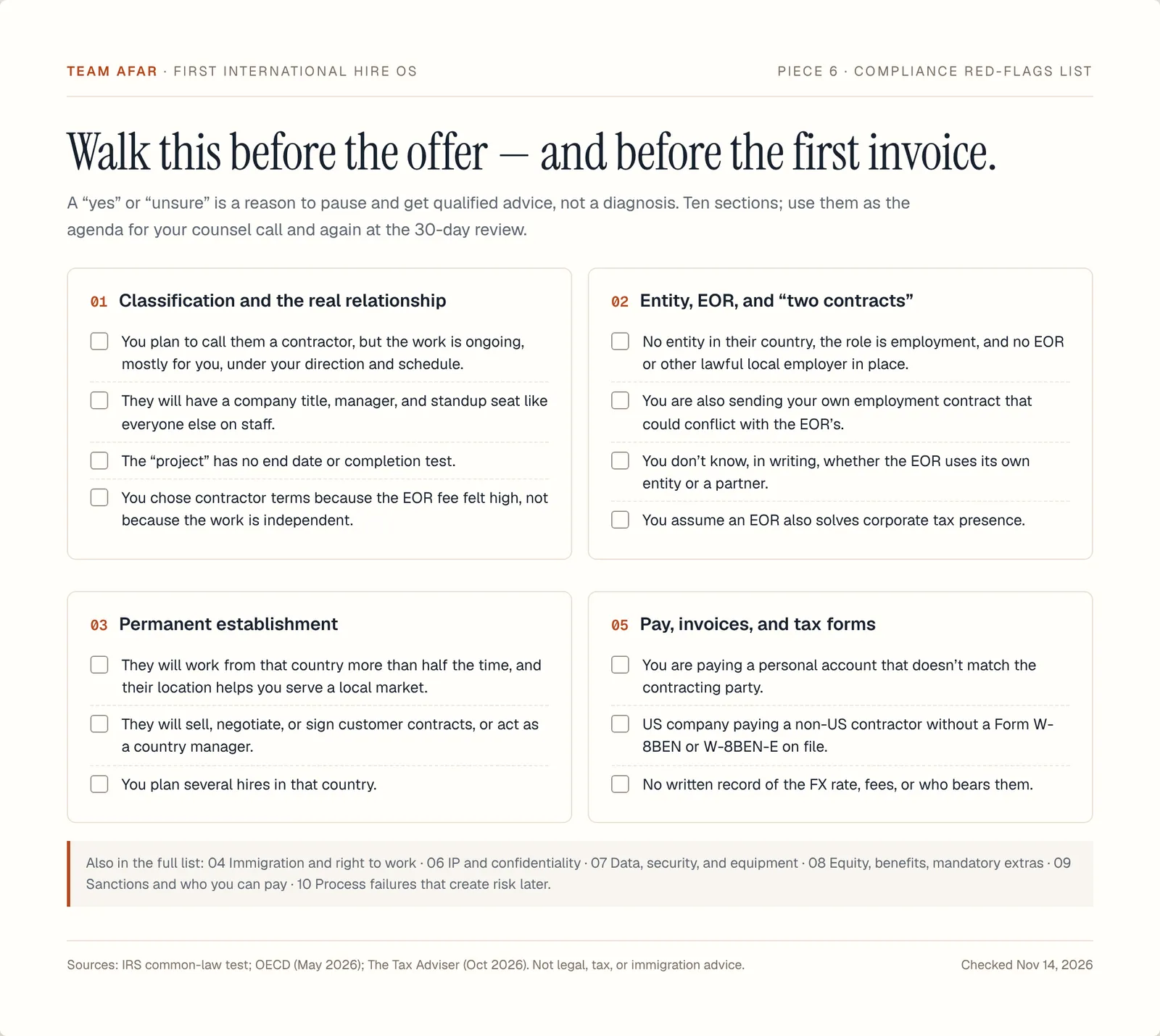
Compliance red-flags list
Ten sections to walk before the offer and before the first invoice — the agenda for your counsel call.
30-day onboarding SOP
Before day one through day 30, with contractor and employee/EOR columns and an owner on every line.
Contractor agreement template (Complete, Agency)
Opens with the warning a buyer needs: counsel reviews it first, and a contractor label doesn’t make someone a contractor. PDF and editable Word.
What changes
From “just send an invoice” to a hire you can stand behind.
01
Pick the right path first
Know whether contractor, employee, or EOR fits before you talk terms with a candidate — not after the first invoice.
02
Know the real monthly number
Salary, statutory costs, mandatory extras, platform fees, and deposit on one sheet before you make an offer.
03
Walk into counsel prepared
Hand your lawyer a marked-up offer letter or contractor draft and a red-flags agenda instead of a blank page.
04
Compare providers on your terms
Send every EOR or contractor platform the same written questions, then score the answers — not the sales demo.
05
Hand off a day one that isn’t improvised
Give whoever runs ops a 30-day checklist with an owner and a due date on every line.
06
Catch the expensive mistakes early
Classification, tax presence, right-to-work, tax forms, and IP — flagged before money moves.
How you use it
Useful in 15 minutes. Done in a week.
First 15 minutes
- 1.Answer the four decision-tree questions for the person you want to hire.
- 2.Write the path you landed on — or “unsure, ask counsel” — at the top of the cost worksheet.
- 3.Enter the offer you have in mind and see which lines you still need a quote for.
First week
- 1.Send the 10 provider questions to at least two EOR or contractor platforms.
- 2.Mark up the offer letter or contractor template with your real terms.
- 3.Book local counsel and use the red-flags list as the agenda.
- 4.Hand the 30-day SOP to whoever runs ops, with an owner on every line.
Full file inventory
Every file, and which tier includes it.
- 01Contractor vs employee vs EOR decision guide + one-page treeAll tiers
- 02Country-cost comparison worksheet (blank sheet, worked example, fee table, official employer-cost data for 12 countries plus Brazil) + cost calculator with 14 sourced country presetsAll tiers
- 03Compliance red-flags list — 10 sectionsAll tiers
- 04Offer letter template, marked for counsel reviewComplete, Agency
- 05Contractor agreement template, marked for counsel reviewComplete, Agency
- 06Country notes for counsel: probation, notice and what a local lawyer usually changes (13 countries, sourced, with a Spain EOR warning)Complete, Agency
- 0730-day onboarding SOPComplete, Agency
- 08Vendor-comparison worksheet + 10 written provider questions + provider SWOT matrix (13 providers A–Z, public starting prices as of 15 Nov 2026, sourced, no referral links)Complete, Agency
- 09First-15-minutes / first-week pathComplete, Agency
- 10Editable Word (.docx) templates, SOP, vendor worksheet, country notes and provider SWOT matrixComplete, Agency
- 11EOR / contractor-platform RFP question packAgency
- 12Editable Word files for every guide and worksheet + multi-hire and client-use licenseAgency
Who it is for
A good fit if…
- You have a real candidate, or a real search, in another country.
- You don’t have a legal entity in that country yet.
- You’re a small software or agency team without in-house employment counsel.
- You want a process you can run once, then hand off to ops.
Not for you if…
- In-house employment counsel already runs this for you.
- You only want a free explainer of what an EOR is — those are already free.
- You need a legal opinion, visa help, or a filled-in cost for your actual hire.
- You need a library of country-specific contracts.
A fair comparison
Where this kit wins — and where it isn’t enough.
Every option here is legitimate. Most teams should use a lawyer no matter what else they choose.
Team Afar kit
- Price
- $97 · $297 (launch price) · $597, one-time
- Provider-neutral
- Yes — provider-neutral. We may earn a disclosed referral fee from some providers; it never changes the comparison.
- Tells you which path to take first
- Gives the questions in order; counsel confirms the answer
- Fill-in cost comparison across paths
- Yes — EOR vs contractor vs own entity, with a source column
- Country-specific contracts
- No — country-agnostic templates, plus per-country notes on what counsel usually changes (13 countries)
- Ops hand-off: 30-day SOP + red flags
- Yes — 30-day SOP and a 10-section red-flags list
- Multiple hires / client use
- Agency tier ($597); Starter and Complete are one company
- Legal advice on your facts
- No — you still need counsel
- Best when
- You’re making the first hire and need the process and files to bring to counsel — Starter if you’re still deciding
Free vendor guides
- Price
- Free (Deel, Remote, teamed.)
- Provider-neutral
- No — published by providers that sell EOR or contractor services
- Tells you which path to take first
- Explains the options; tools lead to the provider’s own signup
- Fill-in cost comparison across paths
- Cost calculators for the provider’s own offer (Deel, Remote)
- Country-specific contracts
- Some generic templates (e.g. Remote)
- Ops hand-off: 30-day SOP + red flags
- Checklists available (teamed., Remote)
- Multiple hires / client use
- Not applicable
- Legal advice on your facts
- No
- Best when
- You’ve already chosen a provider
Local employment lawyer
- Price
- Billed by the hour or quoted per matter
- Provider-neutral
- Yes
- Tells you which path to take first
- Yes, for your facts — the only one that can decide it
- Fill-in cost comparison across paths
- Not usually
- Country-specific contracts
- Yes, drafted for the jurisdiction
- Ops hand-off: 30-day SOP + red flags
- Sometimes, as part of the engagement
- Multiple hires / client use
- Per engagement
- Legal advice on your facts
- Yes
- Best when
- You need a binding answer — use one either way
MeridianHR document library
- Price
- EUR 497, per its Gumroad listing
- Provider-neutral
- Yes
- Tells you which path to take first
- Not its focus: a template library, not a guided first-hire process
- Fill-in cost comparison across paths
- Not its focus
- Country-specific contracts
- Yes — 544 templates across 18 countries
- Ops hand-off: 30-day SOP + red flags
- Not its focus
- Multiple hires / client use
- See its listing’s license terms
- Legal advice on your facts
- No
- Best when
- You need many country-specific documents
Third-party details from public pages checked Nov 15, 2026: MeridianHR’s Remote Employment Document Library; free resources from Deel, Remote, and teamed.. Provider-neutral: we may earn a disclosed referral fee from some providers; it never changes the comparison.
Pricing
One-time price. Pick the depth you need.
Often less than a few hours of specialist counsel — and you should still use counsel. Getting classification wrong can cost far more than either: back taxes, benefits, and penalties in the worker’s country.
Starter
For teams still deciding which path to take.
$97one-time
- Contractor vs employee vs EOR decision tree and full guide
- Country-cost comparison worksheet
- Cost calculator (.xlsx) with 14 sourced country presets: monthly, annual and first-month cost, employee vs contractor
- Compliance red-flags list (10 sections)
- License: One company, internal use
14-day money-back guarantee, no questions asked, one email, no form
Complete
For teams making their first hire abroad in the next 90 days.
$297one-time
Launch price. We plan to raise it to $497 after a lawyer reviews the templates.
- Everything in Starter
- Offer letter template, marked for counsel review
- Contractor agreement template, marked for counsel review
- Editable Word (.docx) versions of the templates, SOP, vendor worksheet and provider SWOT matrix
- Country notes for counsel: probation, notice and what a local lawyer usually changes, 13 countries
- Provider SWOT matrix (PDF + .xlsx): 13 EOR and contractor providers, A–Z, public starting prices and who employs your hire in each country, sourced, as of 15 Nov 2026
- 30-day onboarding SOP with an owner on every line
- Vendor-comparison worksheet + 10 written provider questions
- The first-15-minutes / first-week path
- License: One company, internal use
14-day money-back guarantee, no questions asked, one email, no form
Agency
For agencies and consultants running hires for several clients.
$597one-time
- Everything in Complete
- License for multiple hires and client use
- EOR / contractor-platform RFP question pack
- Editable Word files for every guide, worksheet and template
- License: Multiple hires and client use
14-day money-back guarantee, no questions asked, one email, no form
14-day money-back guarantee, no questions asked
If the kit isn’t a fit, email us within 14 days of purchase for a full refund. One email, no form, no reason needed beyond “it isn’t a fit.”
Checkout
Buy buttons go to the Team Afar Gumroad listings. No tier includes calls or document reviews.
Contractor, employee, or EOR — in plain language
AI-voiced explainer5:16Read the transcript
So you've just interviewed this brilliant developer in Brazil, like they are absolutely perfect. You're ready to send over an offer, but wait. Yeah, hold on a second. Right, because do you make them a contractor, an employee, or do you use an employer of record, like an EOR? Pick the wrong one and that dream hire turns into a massive headache. Oh, absolutely. That's a huge risk. It's a huge risk. So welcome to this deep dive into Team Afar's first international hire OS. Our mission today is to navigate this whole classification maze and uncover the true costs of your first international hire before you pay that very first invoice.
That pre-invoice window is just so crucial. I mean, it's really tempting to just tell your new hire, hey, send me an invoice and promise to figure out the paperwork later. Oh, I've seen so many founders do exactly that. Right, but before you even start looking at payroll platforms, you really have to determine the actual nature of the role you're filling. Let's unpack that a bit. Because if we just slap an independent contractor label on someone who works full-time for us, I mean, isn't that basically like putting a scooter license plate on a semi-truck just to save on fees?
That is a great way to put it. Yeah, because if you get pulled over, the authorities are going to look at the 18 wheels, not the tiny license plate. Exactly. Local labor boards operate the exact same way. You know, you can write whatever title you want on a contract, but if the worker is attending your daily stand-ups, taking your direction and you're setting their hours. Which happens all the time. It does, but if you do that, a contractor label often becomes very hard to defend. Genuine contractors typically have a defined project, they use their own methods, and they serve other clients. So you're buying a specific outcome, not just filling a permanent seat on your org chart.
Right. And we really need to highlight the classification depends on local law. Yes, that is a huge point. It is the worker's country that applies its own specific test. So if the relationship is clearly employment based on those local rules, but you don't have a legal entity in their country, which let's face it, most small teams don't. That is where an EOR steps in. They legally employ the person locally on your behalf. So they handle the payroll and statutory benefits while you manage their day-to-day work.
Okay, so if I go the EOR route, is my total cost just the developer's gross salary plus, I don't know, a quick software subscription fee? Not at all. It's a really common assumption, but no. I mean, the starting platform fees might seem straightforward, like Deel publishes EOR fees from $599 a month and contractor management from $49 a month. Though prices change, obviously. Right, prices change, but the true cost, they go much deeper. So there's this whole iceberg of costs under the surface. How exactly does the budget inflate like that? Well, first you have to budget for employer statutory contributions. Which are basically local payroll taxes, right? Exactly. And then you run into mandatory extras like a 13th month salary.
Oh, wow. So to an American founder, that probably sounds like a performance bonus. It does, but in many parts of Latin America and Europe, it is legally mandated holiday pay. You owe it regardless of performance. Ouch, good to know. Yeah, and add to that FX markups where EORs might pad the currency exchange rate as a sort of hidden fee. Plus, many platforms require these significant refundable deposits up front to cover potential severance risks. Okay, so we've mapped out the budget, but you could have all the money in the world and still step on a legal landmine before day one. Oh, easily. If you aren't looking closely at the paperwork, for sure. So what operational red flag should we be looking for, like before that first invoice even hits? Well, a major one is a mismatch in payment details. Like if their invoice says tech solutions, LLC, but then they ask you to wire the money to their personal checking account. Right, the contracting entities have to match. Exactly. Another huge red flag is assuming an EOR automatically solves permanent establishment risks.
Wait, really? Permanent establishment meaning corporate tax presence. Right. But if the EOR is legally their employer, how could my company get slapped with corporate taxes in Brazil? That just doesn't make sense. Well, an EOR generally solves local employment administration, but it does not magically erase corporate tax risk. Interesting. Imagine your EOR hire in Brazil hits send on a finalized sales contract with a local Brazilian client. In the eyes of the government, your company just did business and concluded contracts on their soil.
Oh, I see. So that could trigger a taxable presence for your company in that country, regardless of who actually runs the payroll. Exactly. The risk isn't just about how they're paid, it's about what they are actively doing for the business. You have to look closely at the actual day-to-day reality of the work being done. And note that in many countries, tax and employment risks depend heavily on specific local facts. That is something to really mull over. I mean, are your international hires accidentally creating taxable mini headquarters for you all over the globe without you even realizing it? It is definitely a scary thought. Truly. Rules vary by country, and this isn't legal advice. Team Afar offers a contractor versus EOR decision tree and a first international hire kit.
Sources
We show our work.
Last checked Nov 15, 2026
Planning data from official government sources for the 12 countries where small teams hire most, plus Brazil, and Wave 2 additions — Ireland, Poland, Portugal, and South Africa — checked 16 Nov 2026, with any gaps marked. A step-by-step method for anywhere else.
Official employer-cost sources, by country
Each country name opens a short hiring guide with the official figures, marked gaps, and what to check before you sign. Or see the full index of guides.
United KingdomVerified
Checked Nov 15, 2026
CanadaVerified (federal + ON/BC/QC basics)
- CRA — CPP contribution rates
- CRA — CPP2 rates
- CRA — EI premium rates
- Ontario — ESA vacation
- Ontario — Employer Health Tax
- B.C. — Annual vacation
- CNESST — Vacances annuelles
- Retraite Québec — QPP 2026
- Revenu Québec — QPIP 2026
Checked Nov 15, 2026
IndiaVerified
- EPFO — Present rates of contribution
- Ministry of Labour & Employment — EPF wage ceiling ₹25,000 (Sep 2026)
- ESIC — RO/SRO contribution rates
- MoLE — Compliance Handbook (Feb 2026)
- MoLE — Compilation of FAQs (as on 25.10.2026)
- MoLE — Code on Wages, 2019
Checked Nov 15, 2026
PhilippinesVerified
- SSS — Contributions
- PhilHealth — Advisory 2026-0042
- PhilHealth — UHC IRR
- Pag-IBIG Circular No. 460 (official text, third-party-hosted)
- PNA — DOLE 13th-month pay rules (Nov 2026)
Checked Nov 15, 2026
SpainVerified
Checked Nov 15, 2026
ColombiaVerified
- VUE — Liquidación de aportes
- MinJusticia — Prima de servicios
- MinJusticia — Intereses de cesantías
- Senado — CST art. 249 (cesantías)
- DIAN — Concepto 7196 de 2025 (art. 114-1)
Checked Nov 15, 2026
ArgentinaVerified — check breakdown
Checked Nov 15, 2026
GermanyVerified (BG and U1–U3 not a single rate)
- Deutsche Rentenversicherung — Werte
- DRV — Beitragstragung
- BMG — Beiträge
- BMG — Finanzierung der Pflegeversicherung
Checked Nov 15, 2026
MexicoVerified except Jalisco ISN
- Orden Jurídico Nacional — Ley del Seguro Social
- Orden Jurídico Nacional — Ley del INFONAVIT
- Congreso de la CDMX — Código Fiscal, art. 158
- Congreso de Nuevo León — dictamen Ley de Ingresos 2026
- PROFEDET — Prestaciones laborales
Checked Nov 15, 2026
AustraliaVerified (federal + NSW/VIC payroll tax)
- ATO — Super guarantee
- Revenue NSW — Payroll tax thresholds and rates
- Victorian SRO — Payroll tax current rates
Checked Nov 15, 2026
FranceVerified
- URSSAF — Taux de cotisations, secteur privé
- Agirc-Arrco — Calcul des cotisations 2026
- Entreprendre Service-Public — Complémentaire santé
Checked Nov 15, 2026
NetherlandsVerified
- Belastingdienst — Cijferbijlage loonheffingen 2026
- Business.gov.nl — Holiday allowance
- Ondernemersplein / SZW — Pensioenregeling
Checked Nov 15, 2026
BrazilVerified (FAP and Simples Nacional not covered)
- Planalto — Lei 8.212/1991 (INSS, RAT)
- Receita Federal — IN RFB 2.110/2022, Anexo III (rates by FPAS)
- Planalto — Lei 8.036/1990 (FGTS)
- Planalto — Lei 4.090/1962 (13th salary)
- Planalto — Constitution, art. 7 (vacation one-third)
- Planalto — Lei 12.506/2011 (notice)
Checked Nov 15, 2026
IrelandVerified (auto-enrolment and Class A assumed for a typical first hire)
- gov.ie — PRSI Class A rates (updated 10 June 2026; rates from 1 Oct 2026)
- gov.ie — Auto-enrolment (MyFutureFund) for employers (updated 14 January 2026)
Checked Nov 15, 2026
PortugalVerified rate; extras not yet booked
Checked Nov 15, 2026
PolandVerified (small-payer accident rate)
- ZUS — Contribution rates (English; updated 23 June 2026)
- ZUS — Stopy procentowe składek na ubezpieczenia społeczne
- Sejm — 2026 Budget Act (Dz.U. 2026 poz. 62), arts. 25–27 (FP 1.0%, FS 1.45%, FGŚP 0.10%)
Checked Nov 15, 2026
South AfricaVerified (UIF with cap; SDL excluded unless threshold met)
Checked Nov 15, 2026
Why these 12: where companies hire abroad
We kept every country named in at least two of these published rankings. Brazil is named in only one (São Paulo on Deel’s city list); we added it because buyers ask about it. All of them come from hiring platforms describing their own customers, so treat them as indicators, not a census.
- Deel — State of Global Hiring Report 2025
Top worker countries and cities on Deel, 2024 data · checked Nov 15, 2026
- Deel — State of Global Hiring Report (Mar 2026)
2025 data; cross-border hire shares quoted below · checked Nov 15, 2026
- Deel — UK talent is in global demand
Cross-border hires by $100M+ startups: UK 12.2%, Canada 11.9%, Germany 8.8%, Australia 5.8%, Spain 5.2% · checked Nov 15, 2026
- CXOToday — coverage of Deel’s 2025 report
Top EOR residence countries: Canada, UK, Spain, India · checked Nov 15, 2026
- Oyster — 2025 Global Hiring Trends & Impact Report (Jun 2025)
Top talent markets for new hires: Philippines, US, India, Canada, UK · checked Nov 15, 2026
- RemoFirst — 10 Global Hiring Trends of U.S. Based Companies (Jul 2026)
Top hiring countries for US companies · checked Nov 15, 2026
- RemoFirst — 5 Global Talent Hubs Small Businesses Are Tapping Into the Most
Fastest-growing markets for small businesses: France, Netherlands, Colombia, Mexico, Australia · checked Nov 15, 2026
Classification, tax and pricing
- IRS — Independent contractor (self-employed) or employee?
US common-law classification factors · checked Nov 15, 2026
- OECD — When does working remotely across borders create a taxable presence? (May 2026)
Permanent-establishment risk from remote work · checked Nov 15, 2026
- The Tax Adviser — PE risk from remote work and the OECD’s new guidance (Oct 2026)
Practitioner commentary on the OECD update · checked Nov 15, 2026
- Deel — Pricing
Published starting fees: EOR from $599/mo, contractor from $49/mo · checked Nov 15, 2026
Rates are copied as each official source states them. Anything we could not confirm on an official page is marked unverified inside the kit. Every figure is a planning input: replace it with a written provider quote before you make an offer.
FAQ
Straight answers.
Which tier is right for me?
What does the license cover in each tier?
Which countries does it cover?
Do I still need a lawyer?
Why pay when Deel, Remote, and teamed. publish free guides?
Do you earn money from providers?
How is this different from MeridianHR’s document library?
What formats do I get, and how is it delivered?
What is the refund policy?
Is this legal advice?
Is it a subscription? Do I get calls or reviews?
Answer the contractor-or-EOR question before the first invoice.
Start with the free checklist and one-page tree. Get the full kit when you’re ready to make the hire.